


Here is the English translation of your text, with no Chinese characters (including punctuation) appearing in the main body. English punctuation has been used throughout.
A customer called two days ago and asked directly: "How much does your pneumatic conveying system cost?"
I thought to myself, is this a beginner or a peer? I asked cautiously: "Do you need positive pressure or negative pressure? Dilute phase or dense phase?" After a long pause and some stammering, the customer replied: "Isn't it just using pipes to transport powder? Why so many complications?"
I said: Don't take this lightly. If you choose the wrong system, you will step into serious traps.
Fragile lithium battery materials, when conveyed with dilute phase, will break into pieces and become completely useless.
For ultra-fine dust, using positive pressure will cause dust to escape from even the smallest pipe leak, turning the workshop into a dust-filled hazard and failing environmental inspections.
For a short distance of just 20 meters, forcing an expensive dense phase system is simply a waste of money.
After half an hour of communication, the customer replied: "No wonder you are a professional powder equipment manufacturer."
Without further ado, let a clear diagram help everyone understand quickly.
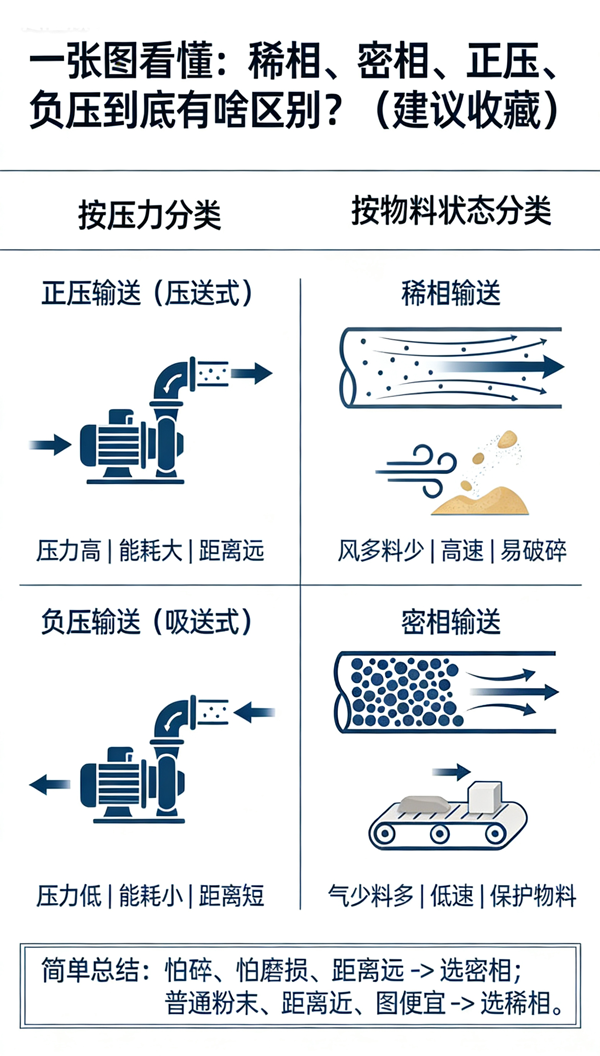
Upper section: Positive Pressure vs. Negative Pressure – Understanding where the power comes from
The core question is: Is the material being pushed or sucked?
Positive Pressure Conveying (Blow type) – In simple terms, it is like using a straw to blow bubbles.
Principle: A Roots blower or air compressor is installed at the pipe's starting point, pushing air forward and driving the material along.
Advantage: One point to multiple points. One large silo can supply material to three different workshops simultaneously, making it ideal for centralized feeding.
Long-distance conveying: The pushing force is much stronger than suction. For long-distance transport of several hundred meters, positive pressure is required.
Negative Pressure Conveying (Vacuum type) – In simple terms, it is like using a straw to drink bubble tea.
Principle: A vacuum pump is installed at the pipe's end, creating negative pressure inside the pipe. The material is pushed into the pipe by atmospheric pressure and sucked away.
Advantage: Multiple points to one point. Several unpacking stations can feed material into a single mixing tank, allowing flexible material collection.
For strict environmental protection or materials prone to leakage: Because the pipe is under negative pressure, even if there is a leak, dust is drawn inward and does not escape outward. For highly toxic or ultra-fine powders with strict environmental requirements, this is the safest choice.
Lower section: Dilute Phase vs. Dense Phase – Understanding how the material behaves inside the pipe
The core difference is whether the pipe contains more air with less material, or more material with less air.
Dilute Phase Conveying (Suspension flow) – A good analogy is a sandstorm.
State: High air velocity, low material concentration. Particles float and tumble rapidly inside the pipe at high speed (15-30 m/s).
Advantage: Simple equipment, low cost, easy maintenance – excellent cost-performance ratio.
Disadvantage: The high speed causes material to collide violently with the pipe wall. Fragile materials like rice or plastic pellets will break. For hard, abrasive materials like emery, pipe elbows will wear through in just three days. This wastes both material and pipe.
Dense Phase Conveying (Plug flow or static pressure) – A good analogy is stuffing sausages or a traffic jam during rush hour.
State: Low air volume, high material concentration. Material moves forward in dense plugs separated by pockets of air. Speed is slow (2-10 m/s).
Advantage: Gentle conveying. Low speed prevents material breakage and minimizes pipe wear – the ideal choice for delicate, valuable materials.
Disadvantage: The control system is complex and the technical threshold is high. However, with Daozhen Zhixiang, professional customization handles this perfectly.
Quick Mnemonic for Pneumatic Conveying Selection
Multiple inlets, use negative pressure
Multiple outlets, use positive pressure
Strict environmental control, choose negative pressure
Long-distance transport, rely on positive pressure
Low cost and durability, choose dilute phase
Fragile and valuable materials, use dense phase
Pipe wear is too problematic? Immediately switch to dense phase!
Daozhen Zhixiang – Professional Pneumatic Conveying Manufacturer
Non-standard design, no wasted expense, more reliable conveying.
Not sure? Let a professional manufacturer provide precise customization.
Pneumatic conveying systems are non-standard custom products. Even for the same material, selection parameters must change with different seasonal humidity. Trying to figure it out yourself is costly and time-consuming. Let Daozhen Zhixiang handle it. Deeply focused on the pneumatic conveying field, we precisely match material, operating conditions, and distance – no wasted expense, and conveying results are achieved in one step.

Top







 location:
