


The Evolution of Milk Powder Mixing Technology: From Basic Homogenization to Intelligent Manufacturing
In the dairy industry, the role of the mixer is far more complex than it appears on the surface. It is not merely a piece of equipment for physically mixing milk powder with other ingredients; it is a critical link in ensuring product quality stability, nutritional balance, and consistent texture. With advancements in food processing technology and the diversification of market demands, milk powder mixing technology has undergone a profound transformation from basic mechanical mixing to intelligently controlled precision manufacturing.
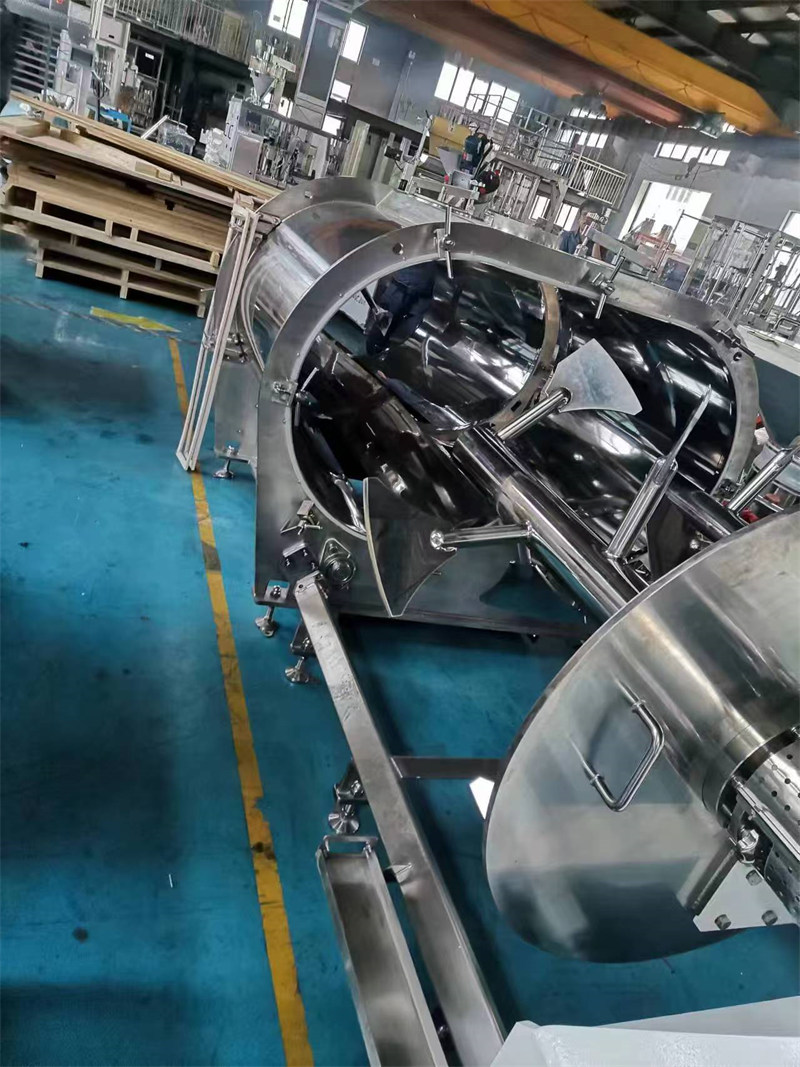
The Essence and Challenges of Powder Mixing
The essence of milk powder mixing is to break up particle agglomerates through mechanical force, achieving uniform distribution of different components at the microscopic scale. This process is influenced by various factors, including particle size, density, shape, electrostatic properties, and ambient humidity. Early milk powder mixing primarily relied on drum-type or paddle-type mixers, which achieved macroscopic mixing through container rotation or internal paddle agitation. However, these devices often had mixing dead spots, making it difficult to achieve ideal uniformity for trace amounts of nutritional fortifiers (such as vitamins and minerals) or functional ingredients, leading to quality fluctuations between product batches.
More importantly, for milk powder, especially infant formula, mixing uniformity directly affects the accuracy of nutritional intake, and standards are extremely stringent. The Codex Alimentarius and various national standards have for the coefficient of variation (CV) of key ingredients, typically requiring it to be below 5%-10%. This has driven mixing technology to evolve toward higher precision.
Technological Breakthroughs: The Application of High-Shear and Fluidized Bed Mixing
To overcome the limitations of traditional mixing, high-shear mixing and fluidized bed (pneumatic) mixing technologies emerged. High-shear mixers use a rotor-stator structure to generate powerful shear forces, effectively breaking up agglomerates of milk powder particles. They are particularly suitable for applications involving fats (which tend to form lumps) or scenarios requiring premixing with small amounts of liquid. They achieve finer micro-mixing and reduce mixing time.
Pneumatic mixing (or fluidized bed mixing) represents another technological path. By injecting controlled, clean, dry air from the bottom of the container, the powder is placed into a fluidized state, where particles move vigorously and randomly within the airflow, achieving fast and gentle mixing. This method provides extremely high mixing uniformity, causes minimal damage to heat-sensitive nutrients, and has no mechanical moving parts that generate friction-induced heat, thus avoiding localized temperature increases that could affect milk powder quality. Modern high-end formula production lines often use this as a key process step.
Intelligent Control and Integration: The Core of Current Manufacturing
Today's advanced milk powder mixing systems have long surpassed the single function of mixing, evolving into intelligent platforms integrating online monitoring, real-time feedback, and automatic control. Near-infrared (NIR) spectroscopy or laser diffraction analyzers can be integrated at the mixer outlet or internally to monitor key component concentrations (such as moisture, fat, and protein) and particle size distribution in real time, with data transmitted instantly to a central control system. The system dynamically adjusts mixing parameters (such as time, speed, and airflow) through algorithmic models (e.g., PID control, model predictive control), achieving a leap from "experience-based mixing" to "data-driven mixing."
This closed-loop control ensures that each batch precisely meets preset standards, greatly reducing human error and product non-conformance rates. Furthermore, the entire process data is recorded and traceable, meeting increasingly stringent food safety regulatory requirements. The mixing process is seamlessly integrated with upstream batching and screening processes and downstream packaging lines, coordinated via PLC or industrial computers, enhancing overall line efficiency.
Future Directions: Flexibility and Sustainability
Market demands are driving milk powder mixing technology toward higher levels of development. On one hand, the increasing variety of products (such as foods for special medical purposes and细分 products for different age groups) requires mixing equipment to have greater flexible production capabilities – enabling quick changeovers, easy cleaning, and flexible small-batch, multi-run production. Modularly designed mixing systems and Clean-In-Place (CIP) solutions are therefore becoming trends.
On the other hand, the concept of sustainable development is gaining traction. Newer mixers are designed to reduce energy consumption, optimize airflow design to minimize dust emissions, and are equipped with efficient dust recovery systems. These features not only reduce raw material waste but also ensure a clean production environment and worker safety. Additionally, equipment materials increasingly emphasize food-grade compliance and durability, reducing chemical and water consumption during cleaning.
Conclusion
From simply pursuing "uniform mixing" to achieving "precise, intelligent, flexible, and green" manufacturing, the evolution of the milk powder mixer reflects a clear trajectory of the entire food industry's transformation and upgrading toward high-end, intelligent production. It is no longer an isolated processing unit but a key node in the data flow and material flow of an intelligent factory, continuously safeguarding the quality and safety from raw materials to finished products. With the further integration of the Internet of Things (IoT), artificial intelligence (AI), and advanced sensor technologies, future milk powder mixing technology will undoubtedly become even more precise, adaptive, and transparent, providing consumers with safer and more stable nutritional products.

Top







 location:
